

Put your hazardous area control system design and delivery in safe hands with MJR Power & Automation, a leading provider of bespoke Control, Automation and Safety Systems for Marine & Offshore applications, in both Safe and Hazardous Area environments.
With over 20 years’ experience in the global Marine, Petrochemical, Nuclear, Process and Offshore industries, MJR provides you with authoritative and practical design leadership throughout all phases of a Hazardous Area Control System development.
MJR’s Hazardous Area Control System design and development services include: FEED, consultancy, conceptual design, detailed design, electrical, instrument & control panel design, PLC & SCADA software design, system construction, installation and commissioning.
Whether plant integrated, modular or ‘on skid’ systems are required, MJR can deliver a wide range of Power & Automation solutions including:
Extensive use of the latest electrical design tools together with fieldbus, networking and remote I/O technologies results in significant savings in design, documentation and build time together with dramatic reductions in hardware and materials such as cabling, glands, tray, wiring, terminals, accessories and cabinet space. Installation time is also vastly reduced. This results in a much more compact, reliable and cost effective solution with reduced delivery time.

For safety critical applications, extensive design experience with the latest hot swap redundant PLCs, Safety PLCs & I/O devices together with resilient control networks enables MJR to deliver systems with the highest levels of safety, integrity, availability and redundancy.

With an implicit understanding of internationally recognised ‘Functional Safety’ standards such as IEC65108 and Offshore/Marine Standards such as DnV-OS-A101 and DnV-OS-D202, there is no safer or more reliable marine and offshore automation partner.
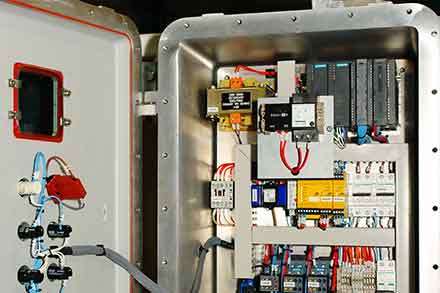
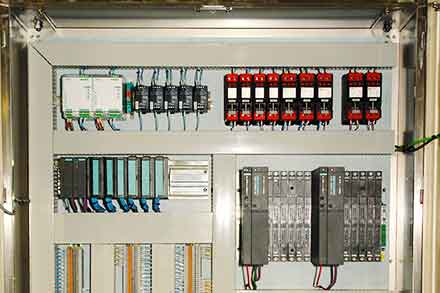
HPU Motor Starters and Control System for Ship to Ship Cargo Oil Transfer Hose Reels and Quick Release Couplings located in Zone 1 and 2. Comprising two 100kW HPU skid mounted Main Motor Starters, one 15kW Auxiliary Motor Starter and a fully redundant PLC/SCADA system.
Dunlop Oil & Gas
Fast delivery, construction commencing before design freeze with multiple design changes, significant volume and weight constraints.
Delivered on time, to budget and specification. Contract extended to include full electrical installation of the system.
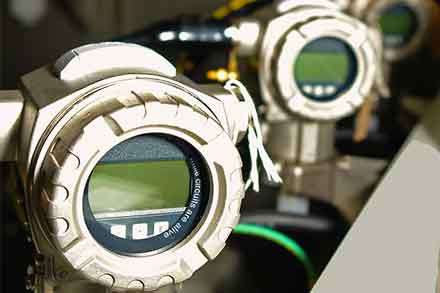
Motor Starter and Power Cabinet design based on the Ex d [Flame Proof] protection concept, whilst Ex nA [Non Sparking] was chosen for the PLC/SCADA Control System. The control architecture was based on dual redundant hot swap Siemens S7-414H PLCs with Profibus & Profinet networking and Siemens ET 200 ISP remote I/O as the interface for the system control panels and sensors located in the Zone 1 environment. This offered reduced space requirements and overall simplification of the system and removed the need for intrinsically safe barrier arrangements.
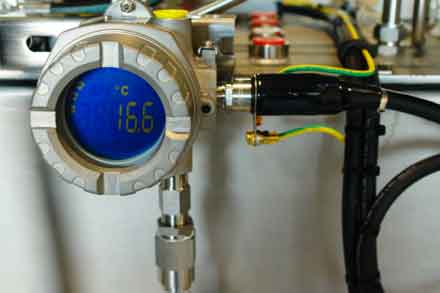
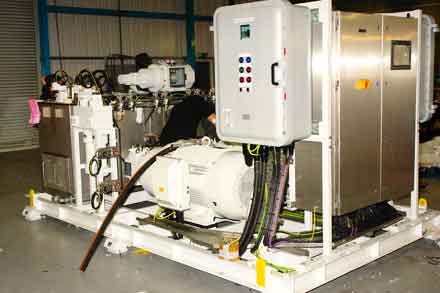
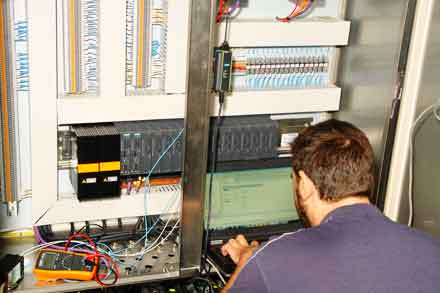
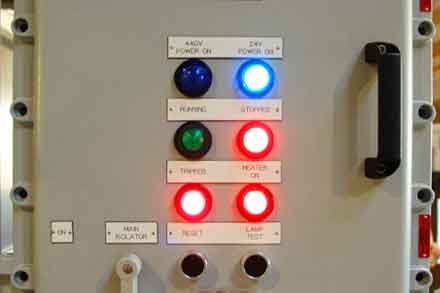
With 7 day working, the system was built, FATed and delivered in 4 calendar weeks. All construction was in house as MJR doesn’t subcontract critical activities such as hardware and software design, construction and commissioning.
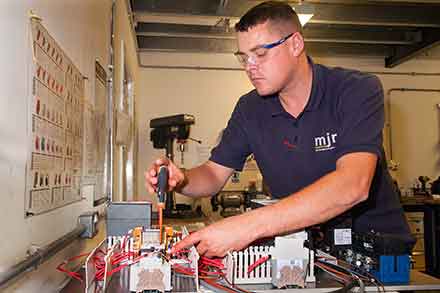
Using our in house installation and commissioning team including CompEx trained and certified installation electricians, technicians and software engineers, MJR carried out the full electrical installation and commissioning at the client facility.
Recent marine projects have included research, design, development and construction of a SIL 2, Zone 1 rated power and control system for an Emergency Release Coupling (ERC) System for use in LNG Ship to Ship and Ship to Shore Transfer.
Hydraulically actuated cryogenic release couplings and dual 100% closure valves coupled with a high integrity, fail safe control system guarantee automatic and safe disconnection and sealing of transfer lines in the event of emergency shutdown conditions. The prototype system, once class and type approved, will be adopted by one of the World’s largest Oil & Gas Explorers and Producers for its LNG cargo transfer operations.
Implementation of hazardous area systems requires a highly structured, top down design approach with close attention to detail at every stage. Aside from defining the normal ‘functional’ requirements via standard means such as Functional Design Specifications, Block Diagrams, Schematics and P&IDs, several additional critical elements must also be considered to ensure safe performance in the hazardous area, for example:
Power Generation, Management & Distribution • Hazardous Area Protection & Packing Concepts • Equipment & Component Selection • Detailed Design Procedures • Documentation & Compliances
Significant additional complexity is also introduced where high levels of redundancy and availability are required and in systems that require Safety Integrity Levels (SIL) such as SIL2 and SIL 3 rated equipment.
The final element of the design, in addition to the ‘as built’ drawings and certification is to provide the inspection
documentation to ensure continuing certification compliance. This will generally include:
Inspection sheets for all elements of the system ensuring compliance with the original hazardous areaes •
Inspection schedule information • <
Hazardous area certification where relevant for all components •
Detailed panel layout designs •
Documents detailing any user adjustable set‐points •
Documentation
Experienced and comfortable with absorbing frequent design change, we understand that rapid design evolution is often a feature of marine and offshore projects.
Working for some of the largest and well known names in the industry, we are trusted to have the knowledge and experience to deliver on time, right first time, every time.
All critical activities such as hardware and software design, construction, testing and commissioning are carried by our in house team. We don’t subcontract mission critical tasks.
Set up for 24/7 working, if required, in order to meet ambitious delivery schedules.
We work to Marine Classification Society Rules (DnV, Lloyds Register, BV, ABS etc) and have years of experience of gaining any necessary and associated approvals and working with class surveyors and approvals departments.
With an experienced offshore technical service and after sales team, our support continues well after the system has left the quayside.